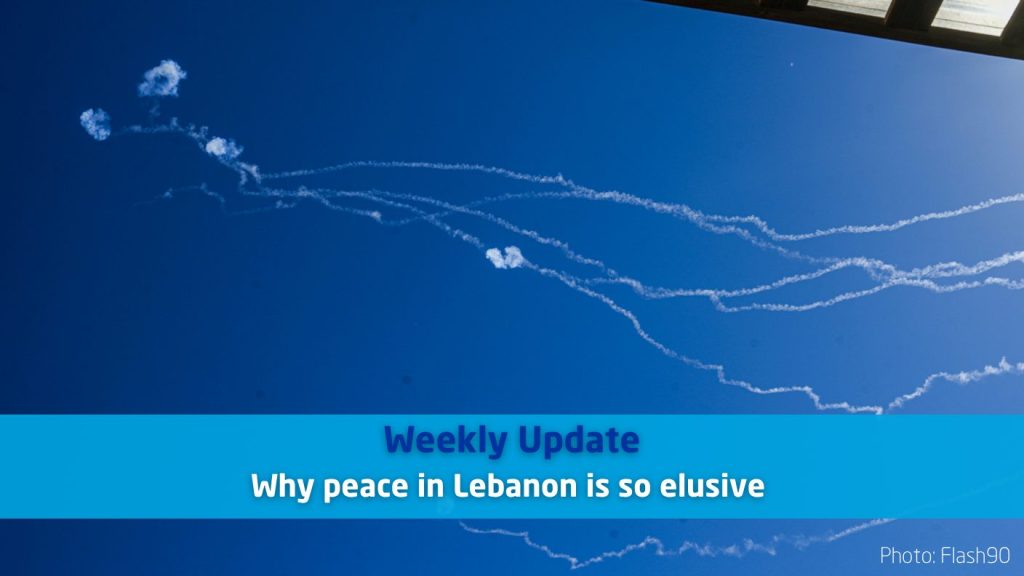


Why Peace in Lebanon is So Elusive
Israel and Lebanon yesterday completed a third day of US-mediated negotiations in Washington without an agreement on a partial Israeli withdrawal from southern Lebanon. Talks will continue today in Washington.
This fifth round of the US-brokered Israel-Lebanon negotiations was supposed to wrap up yesterday. The US hoped it would culminate with the signing of a framework agreement that would include Israel partially withdrawing from small areas of its large buffer zone in southern Lebanon. Israeli troops would then be replaced by members of the Lebanese Armed Forces.
However, it is the USA itself that is undermining the Israel-Lebanon negotiations.
Both Israel and Lebanon are frustrated that the recent US-Iran agreement is interfering with their negotiations. Israel’s Ambassador to the US, Yechiel Leiter, who is leading Israel’s delegation at the negotiations, this week even called the negotiations a “train wreck”. Leiter argued that earlier rounds had been built around a common vision shared by Israel, Lebanon and the United States. He said Washington had played a leading role in advancing efforts aimed at achieving security arrangements and a broader peace process between the neighbouring countries. But the recent agreement has changed the balance of interests, because it links Lebanon with the Iran-US agreement. The US has effectively shifted the goalposts.
“Before four rounds, we all boarded the same train, with the United States serving as the locomotive,” Leiter said. “The train was heading toward a very clear destination: full peace and security between the countries; the removal of Iran and its malicious influence from Lebanon; the dismantling of Hezbollah.”
Leiter said the USA-Iran deal has raised doubts about whether those objectives remain unchanged. “The basic assumption was that Iran was out, and that the central discussion concerned Lebanon and Hezbollah — not the question of how much Iran can restrain Hezbollah,” he said.
According to Leiter, the negotiations should focus on strengthening Lebanese sovereignty rather than assigning Tehran a role in shaping outcomes inside Lebanon. “It is not Iran’s role. Its role is to leave Lebanon. The role of the Lebanese government is to exercise its sovereignty,” he said. “Sovereignty means that Iran will no longer be involved in activity or malicious influence in Lebanon.”
Background: Lebanon, Hezbollah and Iran
In order to understand what is happening, we need to understand Hezbollah’s position in Lebanon. Its relationship with the Lebanese state is one of the most complex in the modern Middle East — a hybrid of integration and parallel sovereignty.
Hezbollah is effectively a “state within a state”. It was founded in 1982 with Iranian backing, initially as a resistance movement against Israeli occupation of southern Lebanon. Over time it built institutions — schools, hospitals, social services, and a military wing — that function independently of the Lebanese government and in some areas surpass it in capability and reach. In the Shia-majority south and parts of Beirut, Hezbollah’s infrastructure is often more present than the state’s.
Hezbollah is also a legitimate political party with seats in parliament and, at various points, ministers in the cabinet. This dual nature — armed militia and political actor simultaneously — is what makes the relationship so fraught. The Lebanese state has never been able (or willing) to disarm Hezbollah, partly because the Lebanese Armed Forces (LAF) are too weak to attempt it, and partly because Hezbollah’s Shia constituency gives it real political legitimacy.
Lebanon’s government is organised around sectarian power-sharing (the Taif Agreement): the president must be Maronite Christian, the prime minister Sunni, the speaker of parliament Shia. Hezbollah operates primarily within the Shia space and has aligned with Amal, the other major Shia political movement, giving the community — and by extension Hezbollah — significant blocking power in government.
Hezbollah seeks the elimination of Israel
Hezbollah was founded explicitly on opposition to Israel’s existence. Its 1985 founding manifesto called for Israel’s elimination, and while its rhetoric has evolved, the organisation’s identity is structurally anti-Israel — resistance to Israel is not a policy position for Hezbollah, it’s the reason the organisation exists. This matters because it means attacks on Israel serve an internal function: they justify Hezbollah’s armed status and its claim to resources, loyalty, and political power in Lebanon.
Hezbollah answers directly to Tehran. It is Iran’s most important regional proxy and functions as part of what Iran calls the “Axis of Resistance.” Iran uses Hezbollah to project power into the Levant, threaten Israel, and maintain deterrence without fighting Israel directly. Hezbollah attacks on Israel often serve Iranian strategic goals — signalling resolve, retaliating for Israeli strikes on Iranian assets, or applying pressure during diplomatic moments. The October 7, 2023 attacks by Hamas triggered Hezbollah’s “solidarity front” in the north, which was partly a coordinated expression of this axis logic.
After Hamas attacked Israel in October 2023, Hezbollah opened a second front in the north, framing it as solidarity with Palestinians in Gaza. This created a sustained low-level conflict that tied down Israeli forces and resources. Even when neither side wanted full war, neither fully stopped — Hezbollah wanted to maintain pressure without triggering a major Israeli response, and it miscalculated how far Israel was willing to go.
Much of the current 2026 fighting is framed by Hezbollah as retaliation: for Israeli strikes on Lebanese territory, for the killing of senior Hezbollah leaders, and — after February 2026 — for the killing of Iranian Supreme Leader Khamenei in US-Israeli strikes. Each Israeli action generates a stated Hezbollah justification for the next round. The cycle is self-reinforcing.
Hezbollah justifies ongoing attacks specifically by pointing to Israeli forces remaining inside Lebanon. Since Israel’s March 2026 offensive pushed forces into the south, Hezbollah has framed continued rocket and drone fire as resistance to occupation — a framing that has some resonance even among Lebanese who are otherwise uncomfortable with Hezbollah’s broader agenda.
Hezbollah rejected ceasefire proposals in June 2026, even as Israel and the Lebanese government were negotiating. But because Hezbollah and the Lebanese state are not the same actor, the Lebanese government can agree to ceasefires, while Hezbollah can decline to honour them. As long as Hezbollah calculates that fighting serves its interests — maintaining relevance, satisfying Iran, resisting disarmament demands — it has little incentive to stop unilaterally.
The through-line across all of this: Hezbollah’s attacks on Israel are simultaneously ideological commitment, proxy obligation to Iran, domestic political tool, and tactical response to battlefield conditions.
This puts Lebanon in an impossible position. The Lebanese state formally does not control Hezbollah’s military decisions. It is legally responsible under international law for actions on its territory, yet unable to stop them. The state has repeatedly disclaimed Hezbollah’s military actions while being unable to prevent them.
The situation since 2024
After the 2006 war, UN Resolution 1701 required Hezbollah to withdraw north of the Litani — it never did. Since 2024, Israel’s military has been pursuing a security zone in southern Lebanon up to the Litani River, with the explicit goal of preventing Hezbollah from reconstituting its military infrastructure close to the border.
Israel sees this campaign as a chance to actually enforce that buffer by force. Stopping now, before Hezbollah is fully disarmed or displaced from the south, would leave the job incomplete and potentially allow Hezbollah to rebuild.
Israel’s military campaign against Hezbollah in late 2024 significantly degraded its military capacity and killed much of its senior leadership, including Hassan Nasrallah. This shifted the balance of power inside Lebanon somewhat, giving the Lebanese state and the LAF more room to assert themselves — particularly in southern Lebanon, where the LAF deployed under the terms of a ceasefire agreement. Whether this represents a durable change in the Hezbollah-state relationship or a temporary weakening remains contested.
The core tension: Hezbollah is simultaneously too embedded in Lebanese society and politics to be treated as a foreign body, and too autonomous from state authority to be treated as simply a Lebanese institution.

A Display Of Weapons Confiscated From Lebanon During The Iron Swords War, In Northern Israel | Photo: Ayal Margolin Flash90
Current Israel-Lebanon negotiations brokered by USA
Following Israel’s renewed military offensive in Lebanon beginning March 2, 2026, Israel and Lebanon opened direct peace negotiations in Washington in March 2026 — the first since the failed 1983 Agreement – brokered by the USA. Formal talks started in mid-April:
- Israel’s PM Netanyahu announced on April 9 that Israel would open direct contacts with the Lebanese government,
- A virtual preparatory meeting was held April 12
- The first in-person session took place April 14 in Washington, hosted by Secretary of State Rubio.
- A 10-day ceasefire was agreed April 16 to create space for talks.
- Subsequent rounds followed on April 23 and May 14-15
- A further round of negotiations took place last week.
The core dispute is over the security architecture of southern Lebanon. Israel wants disarmament before withdrawal; Lebanon wants withdrawal before (or alongside) disarmament. The main issues being negotiated:
- Security zones. Israel has proposed dividing the south into three zones: an inner zone (0-8km from the border) with long-term Israeli military presence, a middle zone extending to the Litani River where Israel would gradually hand off to the Lebanese Armed Forces (LAF), and a zone north of the Litani where the LAF takes sole responsibility. Lebanon is resisting the framing of an Israeli-defined security architecture on its sovereign territory.
- Hezbollah disarmament. Israel wants verifiable disarmament of Hezbollah south of the Litani before withdrawing forces. Lebanon’s government — which can’t unilaterally disarm Hezbollah — is trying to thread the needle by having the LAF deploy and assert exclusive control, effectively sidelining Hezbollah without directly confronting it.
- Israeli withdrawal. Lebanon insists Israeli forces must withdraw as part of any deal. Israel has said it will maintain a presence until conditions are met, which Lebanon and Iran view as an occupation.
- Pilot zones. One area of partial progress: both sides agreed to create test zones where the LAF takes exclusive control, excluding all non-state actors, as a confidence-building measure.
- Enforcement mechanism. The question of who verifies compliance and what happens when either side accuses the other of violations is still unresolved.
What’s been agreed so far
- A conditional ceasefire, contingent on Hezbollah halting fire and withdrawing from the South Litani Sector
- Creation of “pilot zones” where the Lebanese Armed Forces take exclusive control, excluding non-state actors
- A declaration that Hezbollah is an enemy of Lebanon
- A mutual non-hostility commitment between the two states
Why the Iran-USA Memorandum of Understanding is problematic for Israel
The USA-Iran MOU signed last week has complicated the Israel-Lebanon negotiations significantly. Iran now has a separate lever to pressure the Lebanon ceasefire through its broader deal with Washington, changing the incentive structure for all parties. The USA-Iran memorandum calls for cessation of military operations on “all fronts, including Lebanon” and commits to “ensuring the territorial integrity and sovereignty of Lebanon.” Iran is treating this as a USA commitment to stop Israeli operations there. Israel is rejecting that framing entirely — Netanyahu’s government says Israel is not bound by an agreement it didn’t sign. The problem is that Israel wasn’t a party to the MOU, but the agreement purports to bind its behaviour.
Iran has made Lebanon a condition of broader deal compliance — insisting that any violation of the MOU’s Lebanon provisions falls on Washington. This puts the US in an impossible position: it made commitments it can’t enforce, because it can’t compel Israel to stop. Every Israeli strike after the MOU’s signing erodes US credibility with Iran and risks unravelling the wider agreement. US-Iran follow-on talks were reportedly suspended at least once specifically because of continued Israeli attacks in Lebanon.
However, Israel sees Lebanon as its own security problem to solve. The US, in negotiating with Iran, effectively treated Israel’s military operations as a bargaining chip — something Israel finds both presumptuous and dangerous, since it hands Iran leverage over Israeli military decisions through Washington.
Israeli Defence Minister Katz said this week that Israel won’t withdraw from Lebanon yet, and hundreds of thousands of displaced Lebanese residents still can’t return home. A UN Security Council emergency meeting was held this week amid ongoing Israeli strikes.
While Israeli and Lebanese leaders are negotiating in Washington, Israel continues to carry out military operations in Lebanon. Israel carried out strikes Thursday in southern Lebanon against what it said were Hezbollah operatives who posed threats to troops. Hezbollah accused Israel of a “flagrant” ceasefire breach after what it said was an Israeli drone strike that killed three civilians travelling in a car in the Nabatieh district village of Mayfadoun.
The IDF had earlier said that five Hezbollah operatives were killed in the strike. It also said troops killed a Hezbollah gunman in another incident.
This week, let us pray for the Israel-Lebanon negotiations in Washington. Pray for the leaders of Israel, Lebanon and the USA – that they will have much wisdom to achieve their common goal to eliminate Hezbollah in Lebanon.
As the situation in the Middle East becomes more and more complex, peace seems (from a human perspective) to be more elusive than ever. Let us therefore continue to pray for the peace of Jerusalem, and the speedy coming of the Messiah of Abraham, Isaac and Jacob – who alone can protect His people, and usher in a kingdom of peace and righteousness.
‘Train Wreck’
Israel’s Ambassador Leiter Warns Negotiations Are Drifting From Goal of Dismantling Hezbollah
Israel-Lebanon talks extended an extra day as deal on IDF withdrawal remains elusive
Third day of negotiations sees more progress than previous days of current round, which began with mutual frustration at US over Iran deal’s Lebanon truce stipulation, though gaps remain
The US-Iran MOU: Regional Realignments and Lebanon’s Precarious Position
Following the signing of the MoU, the Lebanese front remains a fraught issue
SCRIPTURE FOR THE WEEK:
Psalm 131
1 My heart is not proud, LORD, my eyes are not haughty; I do not concern myself with great matters or things too wonderful for me. 2 But I have calmed and quieted myself; I am like a weaned child with its mother; like a weaned child I am content. 3 Israel, put your hope in the LORD both now and forevermore.